

Tạp chí FLEURNo. 42Pha chế
How to brew Vietnamese phin coffee: 14 grams, hot water and four to six quiet minutes
How to brew Vietnamese phin coffee at home: 14 g of coffee ground like table salt, 120 ml of water just off the boil, a short bloom and four to six minutes.
To brew Vietnamese phin coffee, put about 14 grams of coffee ground like table salt into the phin, wet it with a splash of water just off the boil, wait half a minute, then fill the chamber and let it drip for four to six minutes. That is the whole method: no paper, no pressure, no electricity, only gravity and a small metal cup sitting on the rim of a glass.
What follows is the version we brew at FLEUR, with the numbers, the reasons behind them, and how to read a phin when a cup goes wrong.
What a phin is, and why it is so slow
A phin is a single-cup drip filter, usually aluminium or stainless steel, made of four parts: a wide plate that sits on the glass, a perforated chamber that holds the coffee, a thin press that rests on the grounds, and a lid. The holes in the base of the chamber do the filtering, so no paper is needed.
- Filter plate đĩa lọc
- The wide base that balances the phin on a glass or cup.
- Chamber buồng phin
- The metal cup that holds coffee and water. Its perforated floor is the filter.
- Press nắp nén
- A perforated disc laid on the grounds. Some simply rest by gravity; others screw down so you can set the tightness.
- Lid nắp đậy
- Keeps the heat in while brewing. Turned upside down, it becomes a saucer for the phin afterwards.
Nobody is quite sure where the phin came from. CoffeeGeek calls its origin "not entirely settled", and points to two likely ancestors: the French biggin, an early single-serve drip pot, and the metal drip filter used in southern India. What is clear is how Vietnam made it its own: small enough for one glass, cheap enough for every pavement stall.
An espresso machine forces water through coffee under pressure. A phin only lets water pass as fast as the bed of grounds allows. That is why the time is not something you set. It is the result the phin gives back, and it tells you whether the grind and the dose were right.
A phin is not a slow brewer. It is a clock, and the coffee sets the time.
How to brew Vietnamese phin coffee, step by step
These numbers follow CoffeeGeek's and Nguyen Coffee Supply's published guides, which agree on the dose and differ slightly on temperature and timing. Treat them as a starting point; after a few mornings your own taste is the final measure.
- Warm the phin and glass
Pour a little boiling water through the empty phin into the glass, then discard it. Cold metal and glass steal heat in the first seconds of the brew.
- Add 14 g of coffee and level it
About two rounded tablespoons, ground finer than pour over but coarser than for a moka pot, close to table salt. Shake gently so the surface is flat, then lay the press on top.
- Bloom for 20–45 seconds
Pour 20–30 ml of water, just enough to wet the grounds. They swell and release gas, and the roast aroma rises. CoffeeGeek suggests 20–30 seconds; Nguyen Coffee Supply suggests 45.
- Fill the chamber
Pour another 90–100 ml slowly over the press and put the lid on. The first drop should fall before the two-minute mark.
- Leave it alone
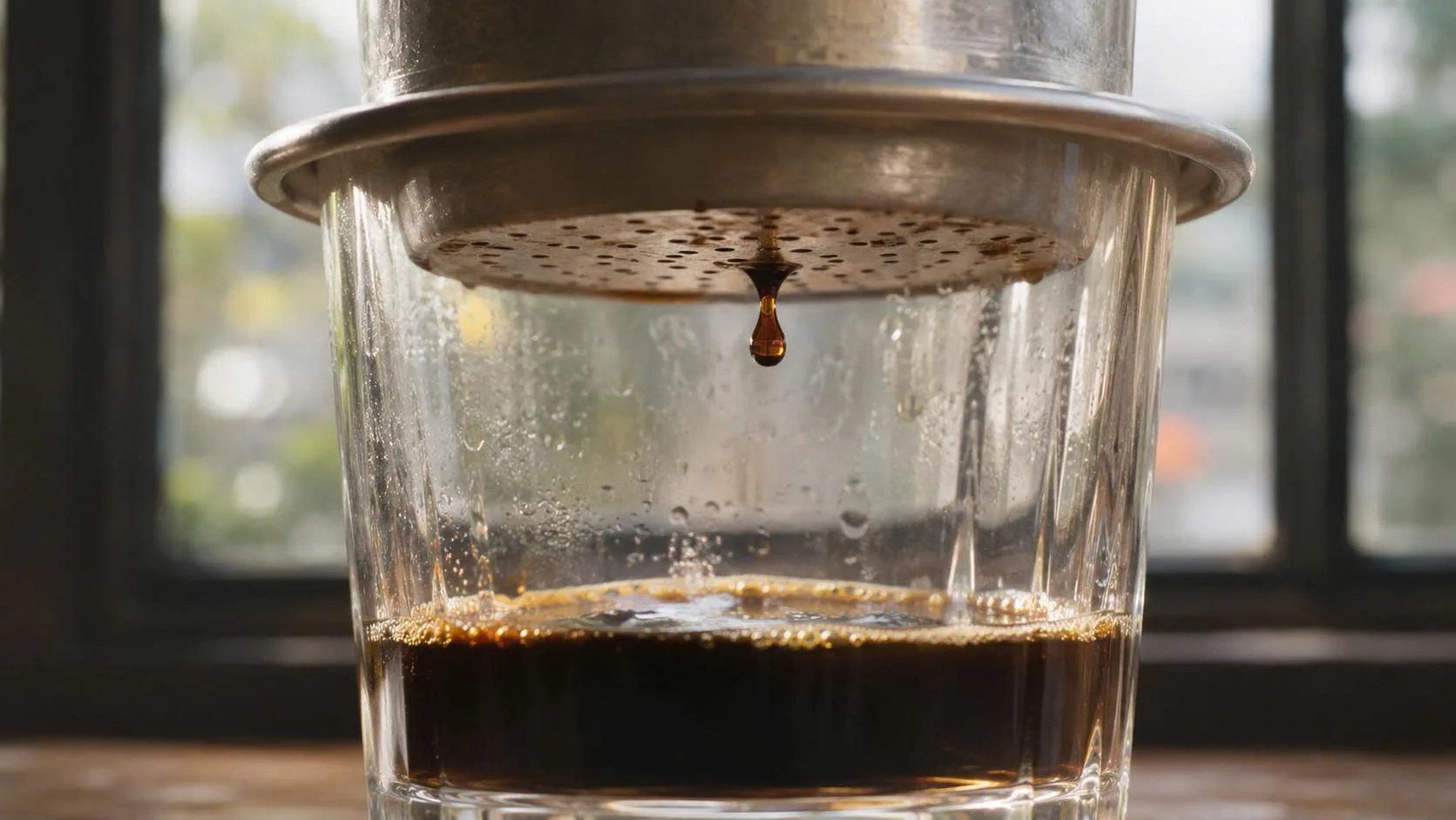
Do not lift it and do not push the press. You want separate drops, not a thin stream. The whole brew takes roughly four to six minutes.
- Turn the lid, lift the phin
When the last drop falls, set the lid upside down on the table and rest the phin on it. Drink it black, pour it over ice, or stir it into condensed milk.
By weight, 14 g of coffee to about 120 ml of water is roughly 1:8.5. That is a strong ratio, far stronger than a Western filter cup. It is meant to be: a phin cup is brewed to stand up to melting ice and a layer of sweet milk.
Cà phê sữa đá: the iced milk version
The cup most visitors remember from Vietnam is cà phê sữa đá, iced coffee with condensed milk. Put about two tablespoons (30 ml) of sweetened condensed milk in the bottom of the glass before you set the phin on it, as CoffeeGeek's recipe does, then brew as above. Stir until the coffee turns the colour of caramel, and pour it over a glass full of ice.
Why condensed milk and not fresh? Coffee reached Vietnam in 1857, and for a long time fresh milk was hard to come by because dairy farming was still in its infancy; tinned condensed milk kept in the heat and brought its own sweetness. The habit outlived the reason. We tell that story in Vietnamese in iced milk coffee and the condensed milk tin.
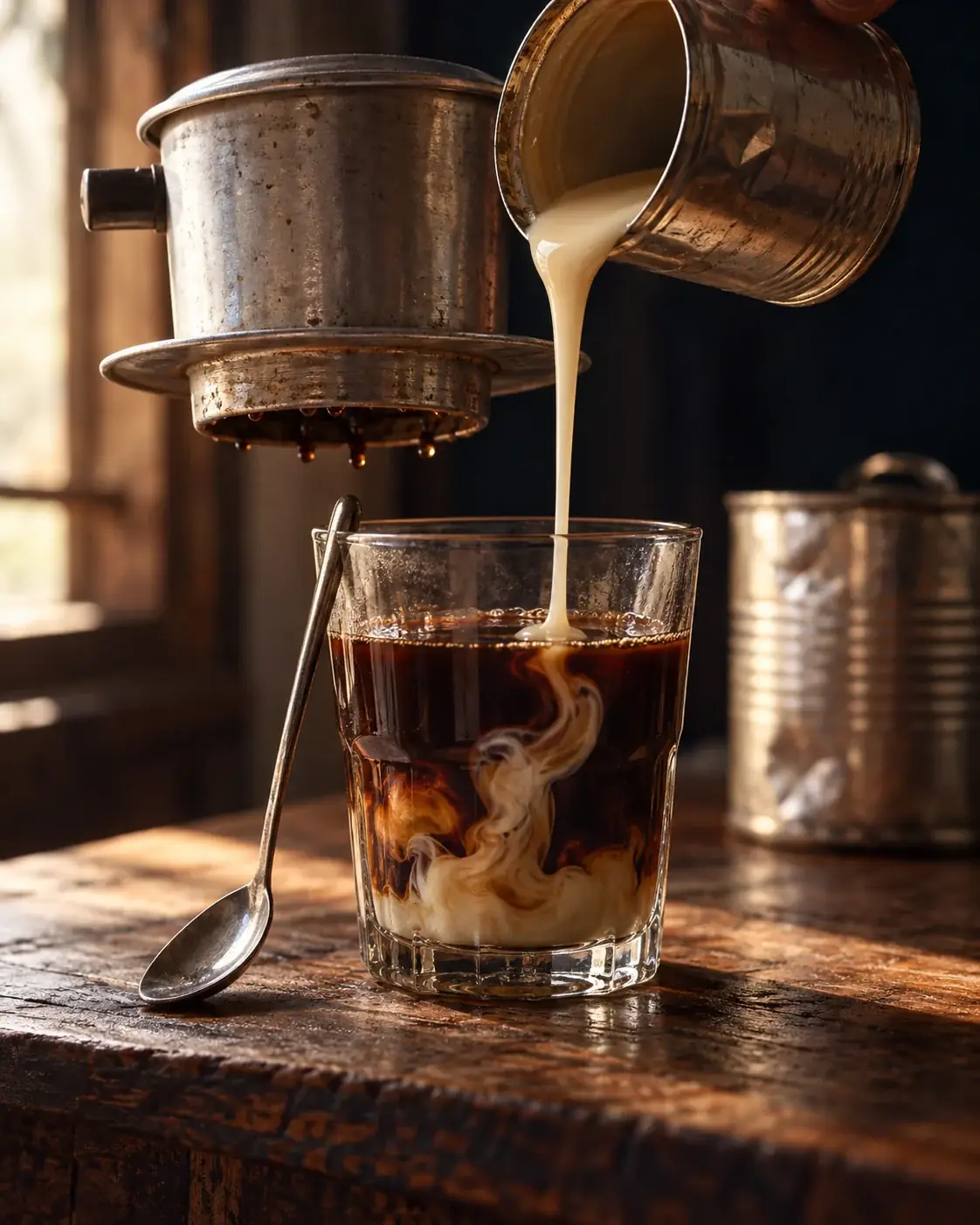
If you prefer it black, cà phê đen đá is the same brew over ice with a little sugar, or none. Served hot, it is simply cà phê đen nóng.
Reading the drip: what to change next time
After a few cups you stop watching the clock and start listening. Steady, separate drops mean a round cup. Drops that run into a stream mean a thin one. Long silence means the grounds have choked. Almost every phin problem shows up in the drip, and almost every one is fixed in the next cup, not this one.
| The phin finishes | The cup tastes | Usually because | Next time |
|---|---|---|---|
| Well under 4 minutes, in a stream | Thin, sour, watery | Grind too coarse, too little coffee, press too loose | Grind one step finer, add a little coffee, pour gently |
| Between 4 and 6 minutes | Strong, round, sweet finish | Grind and dose are right | Change nothing |
| Well over 6 minutes, water pooling | Harsh, bitter, drying | Grind too fine, screw press too tight | Grind coarser, loosen the press |
With a screw-down press, a common trick is to tighten until it just touches the grounds, then back it off about one turn. A gravity press needs no adjusting, only a level bed of coffee beneath it.
Wash the phin while it is still warm. Old coffee oil clogs the holes, slows the drip and leaves a stale smell in the next morning's cup.
Which coffee to use in a phin
The phin grew up with robusta, roasted dark. Vietnam is a robusta country: the USDA forecasts its 2026/27 crop at 32.5 million 60-kilogram bags, 31.4 million of them robusta. Sweet Maria's coffee library notes that robusta carries nearly twice the caffeine of arabica, roughly 2–4.5 percent against 1.1–1.7, and describes it as full-bodied and markedly bitter. In a phin, that body and bitterness are what keep the cup standing when ice and milk arrive.
Grind matters as much as the bean. Espresso-fine coffee will choke a phin; pour-over coarse coffee will rush through it. If you buy ground coffee, ask whether it was ground for phin. Our guide to grind size for phin, espresso, pour over and cold brew has a chart.
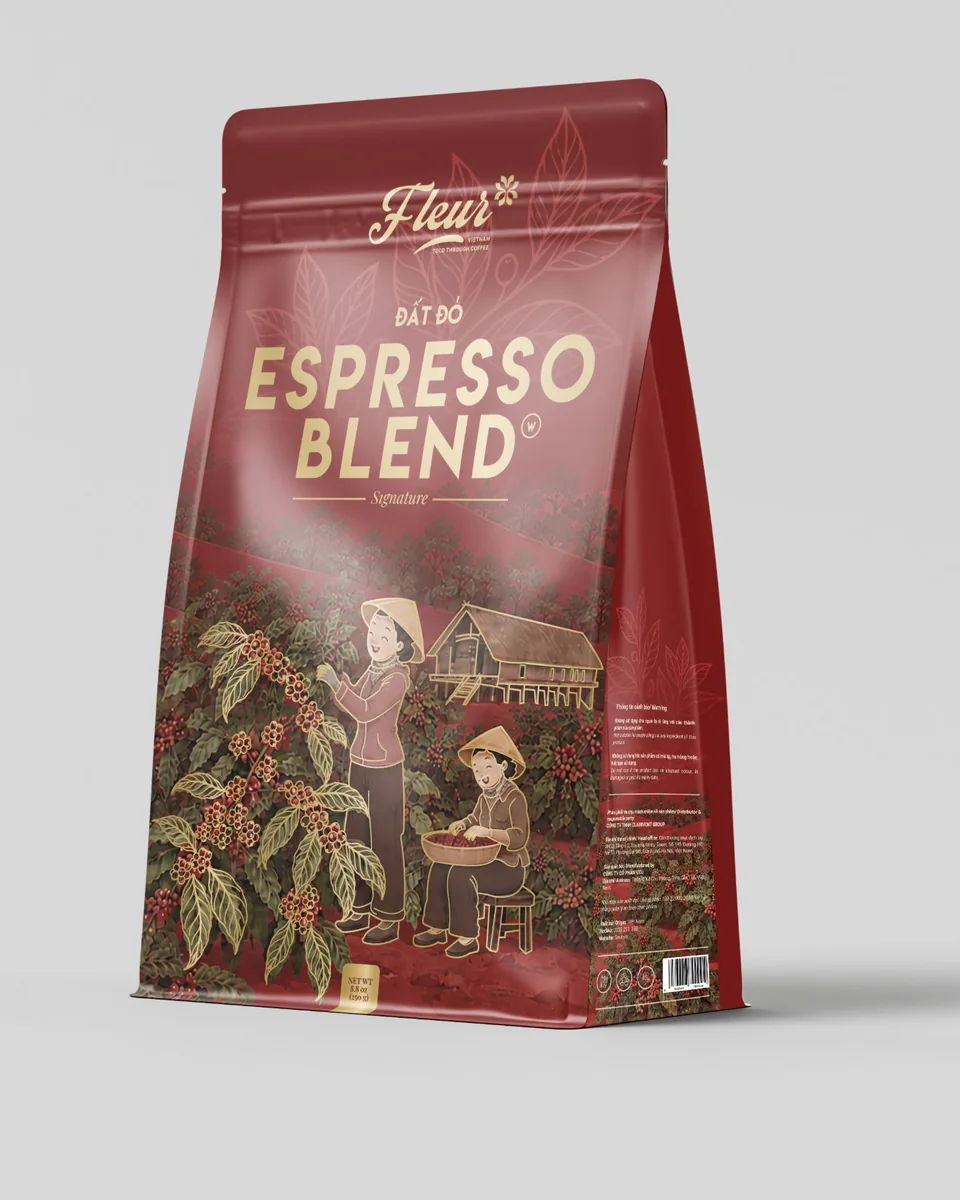
At FLEUR, the blend made for the phin is Bếp Lửa, "Kitchen Fire": 90 percent robusta, 10 percent arabica, ground for phin. It is bold and round, with a gently sweet finish, and named for the warm Vietnamese kitchen where the phin drips every morning.
For mornings without a phin, FLEUR Daily makes a phin-style filter bag of 20 g per sachet, from 23,000 VND. And if you are bringing coffee home as a present, our Vietnamese coffee gift guide covers bags, tins and customs.
Five minutes you cannot hurry
There is a reason the phin is still on so many Vietnamese tables. Four to six minutes is too long to stand and wait, too short to go and do something else, so people sit down. A Hanoi café table, a glass, a phin, a newspaper folded in half: the brew sets the pace of the conversation.
You do not have to brew it that way at home. But the next time the last drop falls and you lift the phin onto its upturned lid, notice that the coffee has given you five minutes back. All three FLEUR blends, with formats and prices side by side, are in our shop.
Bài viết thuộc Tạp chí FLEUR, do Ban biên tập FLEUR thực hiện cùng nhóm nghiên cứu của Clairmont Group. Mỗi con số, mốc thời gian và trích dẫn trong bài được đối chiếu với nguồn công khai liệt kê bên dưới; chỗ các nguồn chưa thống nhất, bài nêu rõ khác biệt thay vì chọn một con số. Thông tin sản phẩm FLEUR lấy theo hồ sơ sản phẩm hiện hành.
Nguồn
- How to Make Vietnamese Iced Coffee – CoffeeGeek
- Traditional Vietnamese Drip (Phin) Brew Guide – Nguyen Coffee Supply
- Vietnam Coffee Report: Production Rising for Third Straight Year – Daily Coffee News (USDA FAS data)
- Robusta Coffee – Sweet Maria's Coffee Library
- Vietnamese iced coffee – Wikipedia (bản lưu Kiwix)